Pages

Showing posts with label trump. Show all posts

Friday, August 07, 2026

7: World War

The Real Meaning of El-Sayed's Victory It's not what you're hearing .......... Corporate Democrats — such as Haley Stevens, along with Rahm Emanuel, Chuck Schumer, and Hakeem Jeffries — aren’t up to the task because they won’t bite the corporate hands that feed them campaign money. They won’t criticize the billionaire class. They refuse to see how big money has corrupted America........... Yet it’s big corporations and the billionaire class that are supporting Trump’s neo-fascism. They’ve sucked up to Trump for corporate welfare, giant tax cuts, tariff exemptions, antitrust acquiescence, and war contracts. They’ve given Trump hundreds of millions for his inauguration, his ballroom, his 250th birthday, his superPAC. .......... Jamie Dimon and Wall Street; Elon Musk and his billionaire bro’s; Brad Carp and his corporate lawyers; Peter Thiel, Jeff Bezos, Mark Zuckerberg, and the Ellisons — all have sold their integrity for huge profits. They’ve created media empires that won’t criticize Trump, financial empires that feed Trump’s crypto, energy empires that feed off Trump’s war, and legal empires that allow Trump to ride roughshod over the rule of law. ......... The Democratic Party isn’t being taken over by Democratic Socialists. There’s no civil war between progressives and moderates. This isn’t about Israel or Netanyahu. We aren’t witnessing an ideological battle between the “left” and the “center.” .......... We’re seeing America wake up to the tyranny that’s engulfed us, and to a crisis of affordability that’s causing most Americans to struggle financially while fueling the biggest stock market rally in history. ........... When corporate America and Wall Street are unleashed — when the president of the United States has made an implicit deal with the moneyed interests to back him and his authoritarian regime in exchange for tax cuts, deregulation, monopolization, and pay-to-play corruption — of course prices soar and wages stagnate. ...........

Tyranny is the handmaiden of the moneyed interests.

............. The Democratic Party’s mega-donor class may be horrified by the rising tide of progressive populism overtaking more than a few primaries this cycle. It spent tens of million of dollars on Stevens — making the Michigan primary one of the most expensive in American history. .......... Too bad. It’s time that the Democratic Party’s mega-donor class recognizes that its real choice is between democracy and tyranny, between an economy that works for all or one that works for a small sliver at the top. If the mega-donor class chooses the latter, it may be acting in its narrow self-interest, but it will also be acting against the future of this nation.

Who's Responsible for This Mess? The media must name names ......... The New York Times says the “Justice Department struggles” with Trump’s demands that it prosecute his enemies. .............. In normal times, the White House and federal departments are also institutions containing professionals with expertise hewed over decades of experience, guided by institutional norms for making decisions and the insights and perspectives that come with their unique roles in the federal government. (I should know. I headed one.) .......... But we’re no longer in normal times. Trump and his sycophants are actively destroying the professional integrity, expertise, norms, and unique insights and perspectives of all these institutions. ............ This characterization hides a crucial reality: The fund doesn’t belong to the Justice Department. It wasn’t even an official offspring of the Justice Department. Instead, it emerged from meetings between Trump’s personal lawyers and acting attorney general Todd Blanche (who was once also a personal lawyer for Trump) over how to dispose of Trump’s $10 billion lawsuit against the Internal Revenue Service. .......... It was never the “Justice Department’s” fund. It was Trump’s fund, right from the start. The same with his deal to immunize himself from IRS audits. ................ Trump had insisted for months that vandals were responsible for the damage, which gained national attention when the pool bottom began to peel and algae blooms turned the pool from blue to green. .............. But in Friday’s court filing, Pirro conceded that problems plaguing the newly renovated pool were caused by a “botched installation not vandalism” and that, had the Department of the Interior “been forthcoming with the information clearly in its possession, the government would not have sought a grand jury indictment.”

The Good News Trump Won’t Mention Crime is plunging, but he can’t handle that truth ...........

every one of Trump’s bombastic claims was completely, verifiably false

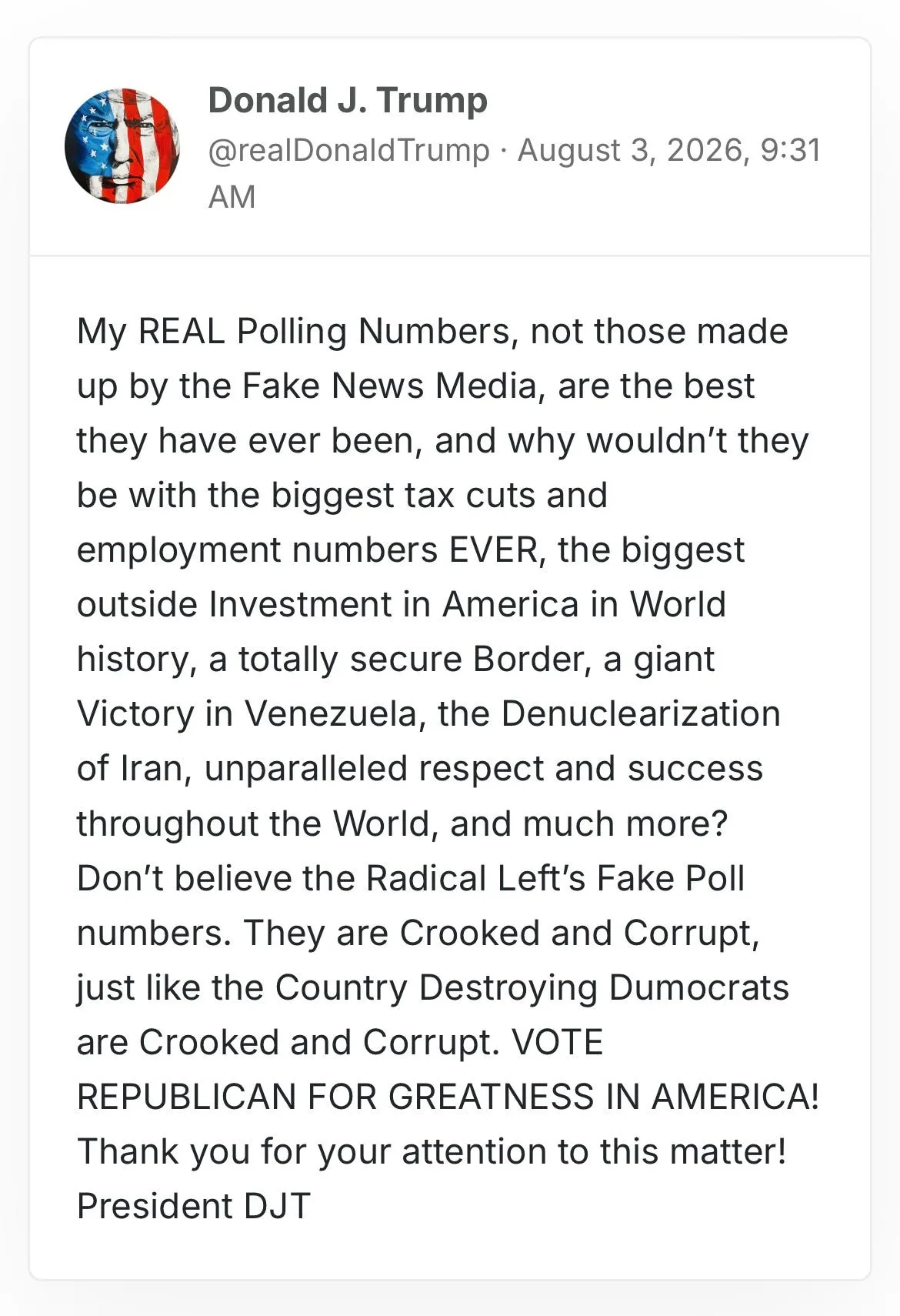
. .............. crime has been plunging. Jeff Asher reports that the number of murders, which rose in the aftermath of Covid but has been declining ever since, is now approaching lows not seen since the 1960s in a number of big cities, with New York probably the safest it has ever been ............. First, Trump (along with much of his party) hates American cities, and isn’t open to hearing anything good about them. Second, he (again along with much of his party) has an image of what life is like in our cities that is 40 years out of date. Finally — and again in accord with his party — he wants to punish people, and acknowledging good behavior would get in the way. ............ About city-hatred: During a Monday White House event Trump went off on a tangent about “blue cities” in which he declared ........... What do they have in common? They’re all dirty. They’re filthy, dirty. Their streets are dirty. Their streets smell. Their storefronts are broken. Their trees are all gross. Everything about the place is dirty............. This wasn’t really a comment about “blue cities,” it was an attack on American cities in general, since almost all major cities — 9 of the top 10, with 95 percent of their combined population — have Democratic mayors. And as usual, try to imagine any public figure saying something similar about rural America. ............... And if one wants to inflict pain — deporting, imprisoning, and, yes, shooting people — it’s necessary to claim that those people are doing terrible things. They’re dirty, they’re disgusting, they’re criminals. Acknowledging that crime is plunging, even while falsely claiming credit, would undermine the case for cruelty. ............. So Trump can’t talk about the fact that crime is down, not even falsely to claim credit, even though falling crime is one of the few ways in which America really is doing much better than it was a few years ago. Instead he must claim that “Radical Left” pollsters — like, for example, Fox News — are hiding his immense popularity, and that his Iran debacle was a great victory.
Monday, July 20, 2026

20: Trump

Office Hours: What Will Trump Do in Iran NOW? There's no good option, so will Trump take the least bad? .......... Trump’s war with Iran has resumed (it never really stopped). The U.S. is sending more warplanes to the Middle East. Two American service members were killed in an Iranian missile attack on Jordan, and a third is missing. The Strait of Hormuz is again closed. Meanwhile, Mojtaba Khamenei issued his first statement following his father’s funeral, saying “revenge is the will of our nation” and that Iran would act against “criminals whose names are known.” In response, Trump threatened to “completely decimate and destroy” Iran if assassination threats against him were acted upon. ............. How long can Iran continue the war? Its economy appears reasonably stable; it has exported oil sufficient to meet its needs. Its population has become used to sanctions and economic pain, and has no voice, in any event. As shown by its attack on Jordan, as well as those on Bahrain, Kuwait, Oman, Syria, and Qatar, Iran has ample missile stocks and has also become more adept at evading U.S. air defense systems. ............ How long can the U.S. continue the war? America doesn’t have sufficient munitions to maintain the current bombing campaign indefinitely. World oil reserves are almost depleted, which means that continued blockage of the strait will cause even more economic pain. Oil has again topped $90 a barrel. Plus, there are midterm elections to think about.

Trump’s War on the Future, Monetary Edition Trying to punish Brazil for adopting a better payment system ............. Pix is essentially a digital version of the real, Brazil’s currency. As a Federal Reserve report from 2022 said, a central bank digital currency — which is what Pix is — “is analogous to a digital form of paper money.” Brazilian banks are required to offer Pix, which the Trumpists claim gives it an unfair advantage over debit cards and other payment methods. But this requirement is similar, at a fundamental level, to the requirement that all U.S. banks accept dollar notes as deposits and disburse dollar notes on demand, which few people would consider unfair. .................. Who is hurt by the advent of Pix? Brazilians’ ability to cheaply make instantaneous payments from their phones certainly hurts the business of Visa and Mastercard, which are both U.S. companies. But since when is it unfair business practice when companies lose business to a competitor that offers a better, cheaper product? For example, should we shut down the U.S. postal service because it offers better and cheaper mail delivery than UPS or FedEx? Should we shut down PayPal and Venmo because they compete with Mastercard and Visa? ............... Beyond concerns about Visa and Mastercard profits, Trump officials are reportedly concerned that Pix and similar payment systems elsewhere might challenge the international dominance of the dollar. In reality, Brazil is too small a player to make much of a dent in the world payments system. The dollar may, however, face a real challenge if the European Central Bank is able, as it hopes, to introduce a digital euro in 2029. If that happens, it’s not hard to imagine that a significant number of transactions that would otherwise have been made in dollars will be made in digital euros instead. ................. the reason people might switch to digital euros will be because the US won’t be offering an equally good means of payment. Why won’t there be a digital dollar? Not because it’s a bad idea — as Brazil has shown, it would be a very good idea. But there are powerful special interests that oppose any such move. ..............

Last year Republicans in the House passed a bill that didn’t just forbid the creation of a U.S. central bank digital currency; it prohibited any study of the issue by the Federal Reserve. “Don’t even think about parking here creating a digital dollar.”

................ Proponents of this ban claimed to have concerns about how a central bank digital currency would work. But it’s obvious that their real concern is that it would work too well. Crypto interests, in particular, are very worried that consumers who had access to digital dollars would lose interest in stablecoins and other cryptocurrency products, because these products, being risky and awkward to use, would not be competitive with a system that simply lets people make electronic payments in dollars. ............ Brazil’s success is especially galling to crypto promoters because it’s in such stark contrast to the results of another Latin American monetary experiment: El Salvador’s attempt to make Bitcoin a major means of payment. The government of President Nayib Bukele made Bitcoin legal tender and spent large sums trying to promote its use. Yet the effort failed: cryptocurrency never caught on as a means of payment, and the plunge in Bitcoin’s price since last fall has inflicted large losses on El Salvador’s government. ..............

If we can have a digital dollar, why not a public option for health insurance?

.............. the furious opposition to central bank digital currencies reminds me of the Trump administration’s all-out efforts to block development of wind and solar power. In both cases we see political players beholden to special interests — crypto when it comes to money, fossil fuels when it comes to energy — who claim to favor technological progress, but scream “not like that” when a superior technology doesn’t take the economy where they want it to go. ......... using tariffs to punish Brazil for its monetary achievements won’t succeed. Politically, the move will only strengthen Brazil’s President Lula. Economically, the reach of the tariffs will be limited by Trump administration fears about driving the prices of coffee, orange juice, beef and other goods even higher. And as Monica de Bolle at the Peterson Institute for International Economics argues, Trump’s tariffs have on balance strengthened Brazil’s position: “Trade diversion around the globe as a reaction to US tariffs has turned Brazil into an export powerhouse,” with Brazil, for example, capturing much of the Chinese soybean market.

The US and Iran have blown past red lines as they lurch back toward all-out war
Texas Hispanics swung hard to Trump. A new poll shows they’re furious at his deportations. A new survey of Hispanic business owners in Texas shows Democratic nominee James Talarico dominating......... Benny Melendez voted for President Donald Trump in 2024. But since Trump returned to the White House, it has been increasingly difficult for Melendez to run his small construction company in south Texas. He says immigration officers have detained workers at his job sites and while driving his company trucks. Since the beginning of 2025, more than 10 of those workers have been deported.......... The chaos of the past year-and-a-half has convinced Melendez to abandon his support for Trump and Republicans, and instead back the Democrat in this year’s U.S. Senate election, state Rep. James Talarico. .......... “How can we continue voting for someone that is targeting our community?” Melendez said. “There’s no way possible we’re going to support that. No way.” .............. One in five Hispanic business owners in Texas say they’ve had an employee deported in the past year ........... Seven in ten said their businesses had been impacted by Trump’s tariffs. Among those surveyed, Talarico holds a seven-point lead over Attorney General Ken Paxton, the GOP nominee, even though a plurality of the over 1,000 respondents self-identify as Republican. Almost one quarter who supported Sen. John Cornyn in the Republican primary now say they’ll back Talarico, while over half say they’ll back Paxton. .......... Hispanic voters around the country are swinging hard against him, thanks to the Trump administration’s immigration crackdown and the shaky economy. ............ “If you’ve got a small business of 10 people or so, and you get even one person deported, you can imagine what that does to the morale of that business unit and to the fear of the business owner.” .................. The Texas Senate race will be one of the nation’s most watched — and most expensive — this cycle. Early polling shows it in a dead heat: A New York Times/Siena poll released last month showed

Paxton and Talarico tied

. Among Hispanic voters, Talarico led by 32 points. In 2024, Trump won Texas Latinos by 10 points. .................. In a statement, Talarico offered an olive branch to Hispanic voters: “We should be supporting Hispanic small businesses — not crushing them under the weight of high costs and failed immigration policies,” he said. “Here’s my message to Hispanic communities across Texas: if you feel like you’ve been conned, if you feel like you’ve been let down by both political parties, if you feel like politicians aren’t doing anything to lower your costs or fix this broken immigration system — you’ve got a place in this campaign.” ................. “I didn’t like what Biden was doing here on the border,” Melendez said. “But now with Trump, it’s all the opposite, 180 degree change. He doesn’t let us work. He’s taking the best we have.” ............

blockquote class="twitter-tweet">

you can be austere in a bustling city

— Paramendra Kumar Bhagat (@paramendra) July 18, 2026

Thursday, June 18, 2026

18: Trump

Friday, June 12, 2026

12: Trump

Did Trump Promise "No Wars" If Elected? Of course he did. Here's the record. And he — and congressional Republicans who encouraged and enabled his war in Iran — should be held to account for it.

Tuesday, May 12, 2026

12: Trump

Monday, April 20, 2026

20: Trump

Paul Krugman: The Harm from Hormuz

Iran: Podcasts

Paul Krugman: The Harm from Hormuz Why we should still fear a global slump from Trump’s Iran debacle ............... Another week, another false all-clear. ............... The Strait of Hormuz remains closed. It appears increasingly obvious that the 20 percent of world oil supply that normally flows through it to world markets won’t be restored to normal anytime in the near future — quite possibly for many months. What will this disruption do to the world economy? ...................

a full-on global recession is more likely than not if the Strait remains closed for, say, another three months, which seems all too possible.

.................... there is a wide range of price scenarios, from $99/bbl to

$372/bbl

............. One way or another, the world will have to burn significantly less oil in the near future than it would have if this war had been avoided. In the jargon of energy analysts, there will have to be large “demand destruction.” But how can oil demand be destroyed? ................... People can just do less overall — consume less, produce less. That is, we can reduce oil consumption by having a global slump. And demand destruction through a global slump can happen quickly. ...............

The closest parallel I know to the Hormuz crisis is the oil shock that followed the 1973 Yom Kippur War.

............. A comparable slowdown now would mean zero or negative world growth over the next two years, compared with the current IMF forecast of 3 percent. This would be a true global disaster. ............... First and foremost is the likelihood that a deal to reopen the Strait will in fact be struck. Basically, the U.S. can get the Strait reopened by loudly proclaiming victory while quietly accepting de facto defeat. All this will take is for Trump to accept reality, admittedly a hard climb. ..................

Given time — even a year or two — the world could make major shifts to other energy sources.


Paul Krugman’s April 20, 2026 Substack article “The Harm from Hormuz” frames the ongoing closure of the Strait of Hormuz as a self-inflicted U.S. strategic and economic disaster stemming from the Trump administration’s Iran policy (what he calls “Trump’s Iran debacle”).
The piece focuses primarily on the macroeconomic fallout: the strait normally carries ~20% of global oil supply, and its closure has created a physical supply shock comparable to (or worse than) the 1973 Yom Kippur War oil crisis. Krugman argues that even the IMF’s “slowdown” forecast is too optimistic; a full global recession is “more likely than not” if the strait stays closed another three months, with demand destruction occurring mainly through economic contraction rather than easy substitution. He notes lower U.S. oil intensity than in 1973 but emphasizes that remaining demand (suburban driving, trucking in emerging markets) is harder to compress quickly. The article implies a possible off-ramp—Trump “loudly proclaiming victory while quietly accepting de facto defeat”—but offers no granular details on negotiations, the nuclear program, or enriched uranium. It treats the closure as effectively permanent in the near term and the war as a lost cause for regime-change or maximalist goals.
To address some specific questions, here is a full, sourced timeline and analysis drawn from the war’s documented events, negotiations, and the strait’s status.Negotiations Timeline (Pre-Ceasefire Through April 20, 2026)Negotiations predated the war but were repeatedly interrupted by military action. The core issues have always been Iran’s nuclear program (enrichment rights, facilities, stockpiles) and, post-February 28, control of the Strait of Hormuz.
  • 2025 (pre-war phase): Indirect talks began in March–April 2025 after Trump’s letter to Supreme Leader Ali Khamenei demanding full dismantlement of enrichment, zero enrichment, and proxy disarmament in exchange for sanctions relief. Multiple rounds (Muscat/Oman, Rome) produced Iranian counteroffers: temporary enrichment caps (to 3.67%), stockpile dilution/transfer to a third country, IAEA inspections, and proxy concessions. The U.S. insisted on permanent zero enrichment and facility dismantlement (Natanz, Fordow, Isfahan). Progress was claimed but talks collapsed after Israeli strikes in June 2025.
  • Early 2026 (pre-war resumption): Indirect rounds resumed (Muscat Feb. 6; Geneva Feb. 26). Iran offered to dilute 60% enriched uranium; the U.S. demanded destruction of facilities and full stockpile handover. “Significant progress” was reported on verification, but talks ended with the U.S./Israeli strikes on Feb. 28.
  • Ceasefire (April 7–8, 2026): A two-week U.S.-Iran (and nominally Israel-involved) ceasefire was brokered by Pakistan, with China’s nudge to Khamenei’s successor. Iran agreed to safe passage through the strait as a core condition; Trump framed it as victory. The strait remained restricted, and disputes arose over whether it covered Lebanon fighting.
  • Post-ceasefire Islamabad talks (April 11–12, 2026): First face-to-face round (U.S.: Vance, Witkoff, Kushner; Iran: Araghchi, Qalibaf). Lasted ~21 hours; collapsed with “gaps on major issues” and “no trust.” Key proposals: U.S. demanded a 20-year suspension of all enrichment, dismantlement of facilities, and handover of the entire enriched-uranium stockpile (hundreds of kg of highly enriched material, some previously moved underground). Iran countered with a 3–5 year suspension (or 5 years per some reports), retention of peaceful enrichment rights on its soil, and no full dismantlement/handover. Hormuz management was the second major impasse—Iran sought a formal regulatory role; the U.S. demanded unrestricted open access.
  • Immediate aftermath (April 12–20): Trump announced an immediate U.S. naval blockade of Iranian ports and strait-linked shipping. Iran briefly announced a full reopening (April 17) for commercial ships, but reversed it within 24–48 hours (April 18), citing the ongoing U.S. blockade as a violation. U.S. forces seized an Iranian-flagged cargo ship (Touska) near the strait on April 19; Iran called it “maritime piracy” and vowed retaliation. As of April 20, Iran has “no plans” or “no date” for new talks; Pakistan is preparing possible follow-on rounds, but Tehran describes U.S. demands as “unreasonable.” The two-week ceasefire is expiring or under extreme pressure.

Ups and downs summary: Early 2025 showed constructive moments and Iranian flexibility on temporary limits/stockpile moves. Momentum repeatedly collapsed due to Israeli strikes (June 2025, Feb. 28, 2026), mutual mistrust (post-2018 JCPOA withdrawal), and maximalist U.S. demands. The April ceasefire was a genuine “up,” producing a temporary opening announcement, but the Islamabad round was a sharp “down”—the nuclear duration gap (20 vs. 3–5 years) and Hormuz control proved unbridgeable. Trump’s blockade move escalated pressure but triggered Iran’s re-closure, creating the current deadlock.Status of the Strait of Hormuz Since February 28, 2026
  • Feb. 28 onward (war phase): Iran immediately restricted or closed the strait to nearly all commercial traffic (>90% drop). Passage required Iranian permits, fees, or “safe conduct”; gunboats, mines, and warnings enforced compliance. Selective allowances were made for Iran-linked or negotiating-country vessels. This cut off ~20% of global oil flows.
  • Ceasefire period (April 7–17): Partial/selective easing occurred, but the strait never returned to pre-war open status. Iran cited continued Israeli actions in Lebanon as justification for restrictions.
  • April 17–18 reversal: Iran announced full reopening for commercial ships (April 17), boosting markets temporarily. Within a day it reimposed a full closure (April 18), firing warning shots and declaring no vessel movement without permission. Reason: U.S. blockade of Iranian ports and continued interdiction of strait traffic.
  • April 19–20 (current): Strait remains fully closed. U.S. Navy has seized at least one Iranian vessel; Iranian gunboats are active; commercial shipping is at a standstill. Oil prices have spiked again.
In short: closed/restricted since Day 1 of the war, with one very brief, aborted reopening.Where We Stand Now (April 20, 2026)Fragile two-week ceasefire is effectively on life support or expiring. The strait is closed, U.S. blockade is active, and direct talks are stalled with no confirmed next round (though Pakistan is trying). Iran retains significant leverage via the strait and has demonstrated it can impose global economic pain. The U.S. has not achieved regime change or nuclear capitulation. Krugman’s analysis captures the mounting pressure: prolonged closure risks a global recession that would hurt the U.S. and allies far more than Iran in relative terms.What Is Likely in the Near Future?Economic self-interest points toward de-escalation. Global oil markets, Asian fuel shortages, and recession risk create strong incentives for both sides to extend the ceasefire and reach a limited deal that reopens the strait. Trump has repeatedly signaled a desire for a quick “win” he can tout. A plausible outcome (Krugman’s hinted path): U.S. accepts a face-saving compromise—perhaps a short-to-medium enrichment pause (5–10 years), partial stockpile relocation (e.g., to Russia), enhanced IAEA access, and formal international guarantees on strait openness—while quietly dropping maximalist “zero enrichment forever” demands. Iran, bruised militarily but economically empowered by the strait weapon, is likely to accept sanctions relief and a face-saving “peaceful nuclear right” clause. Full war resumption is possible if talks collapse entirely, but the mutual pain (especially oil prices) makes that less probable than a messy, imperfect truce.Chances Iran Agrees to End Its Nuclear Program and Hand Over All Enriched UraniumLow (near zero in any realistic near-term deal).
Iran has repeatedly stated it will not surrender its “inalienable right” to peaceful enrichment on its own soil. Senior Iranian officials have explicitly ruled out any scenario in which Tehran “entirely give[s] up enriching uranium” as part of a peace deal. Pre-war and post-ceasefire proposals from Iran involved only time-limited suspensions (3–5 years) or dilution/transfer of portions of the stockpile—not zero enrichment, facility dismantlement, or full handover of all enriched uranium (estimated hundreds of kg of highly enriched material). U.S. demands for a 20-year ban plus complete stockpile surrender are viewed as surrender terms. Iran’s demonstrated Hormuz leverage, surviving the initial strikes, and deep mistrust after the 2018 JCPOA withdrawal make total capitulation politically impossible for its leadership. A deal that ends the war and opens the strait is achievable with compromises on duration, inspections, and partial stockpile moves—but not the maximalist outcome described.

Overall, the situation is a classic “mutually hurting stalemate”: Iran can choke global oil, the U.S. can sustain a blockade and inflict further damage, but neither can win outright without catastrophic costs. History (1973 oil shock, past nuclear talks) suggests an imperfect diplomatic off-ramp is the most probable path, even if it falls far short of the “end the nuclear program forever” goal. The next few days—expiry of the two-week ceasefire and any Pakistani-mediated follow-up—will be decisive.