
No, there is no credible evidence that the CIA killed Homi J. Bhabha. The claim is an unsubstantiated conspiracy theory that has circulated for decades but rests on a single, highly dubious source with no corroboration from official investigations, declassified documents, or independent evidence.
The Facts of Bhabha’s DeathHomi Jehangir Bhabha, the pioneering Indian nuclear physicist and founder of India’s nuclear program (often called its “father”), died on January 24, 1966, at age 56. He was a passenger on Air India Flight 101 (a Boeing 707-437 named Kanchenjunga), which crashed into Mont Blanc in the French Alps while approaching Geneva. All 117 people on board were killed.
The official investigation by France’s Bureau d’Enquêtes et d’Analyses (BEA, the equivalent of the NTSB) concluded it was an accident caused by controlled flight into terrain (CFIT) due to pilot error:
This claim is not credible for multiple reasons:
In short: The crash was a tragic aviation accident, as determined by the official inquiry. The CIA assassination story remains an unproven conspiracy theory with no supporting facts. India’s nuclear program continued after Bhabha’s death regardless, and the truth about his death aligns with the documented evidence, not the rumors.

The official investigation by France’s Bureau d’Enquêtes et d’Analyses (BEA, the equivalent of the NTSB) concluded it was an accident caused by controlled flight into terrain (CFIT) due to pilot error:
- The aircraft departed Beirut with one VOR (radio navigation aid) unserviceable.
- The captain miscalculated the plane’s position relative to Mont Blanc and reported an incorrect estimate to air traffic control (ATC).
- Geneva radar controllers spotted the error and tried to correct it, but unclear phraseology led the crew to believe they had already cleared the ridge.
- The plane continued descending and struck the mountain. Factors like possible whiteout conditions (all-white snow/cloud environment) and low sun angle may have contributed to the misjudgment.
- Wreckage analysis confirmed the engines were operating normally until impact; the nose gear showed compression damage consistent with a high-speed mountain strike. No signs of explosion, sabotage, or external interference were found.
- The U.S. was indeed opposed to India developing nuclear weapons in the 1960s (amid Cold War dynamics and India’s non-aligned stance leaning toward the Soviet Union).
- Bhabha’s death came shortly after Prime Minister Lal Bahadur Shastri’s (another unproven conspiracy target).
This claim is not credible for multiple reasons:
- Douglas is widely regarded as an unreliable narrator—a conspiracy theorist, Holocaust denier, and accused forger. Even many conspiracy communities dismiss him as a “pariah” or fabricator. Reviews of the book frequently call it fiction or dubious.
- No recordings, transcripts, or independent verification of the alleged conversations have ever been produced. Crowley’s family and former colleagues have not corroborated it.
- No declassified CIA documents, U.S. government admissions, or parallel investigations (Indian, French, or Swiss) support sabotage. Wreckage recovered over decades (including in recent glacier melts) shows no bomb residue or explosive damage.
- Killing 116 other people (including diplomats and civilians) in a public commercial flight to target one scientist would be an extraordinarily risky and detectable operation—yet zero forensic or intelligence evidence has emerged in 60 years.
In short: The crash was a tragic aviation accident, as determined by the official inquiry. The CIA assassination story remains an unproven conspiracy theory with no supporting facts. India’s nuclear program continued after Bhabha’s death regardless, and the truth about his death aligns with the documented evidence, not the rumors.
Homi Jehangir Bhabha (1909–1966) is universally regarded as the father of India’s nuclear program. A brilliant theoretical physicist (known for “Bhabha scattering” in quantum electrodynamics), he shifted from pure research in Europe to nation-building in India, creating the institutions, infrastructure, and long-term strategy that turned a newly independent country into a nuclear-capable power. Institutional Foundations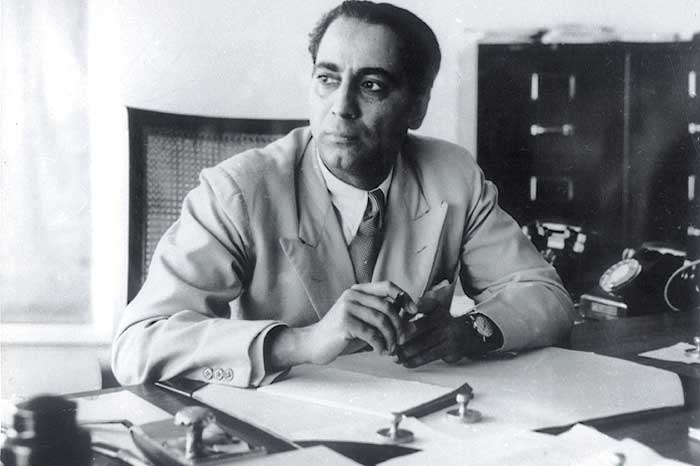

Landmark Achievements
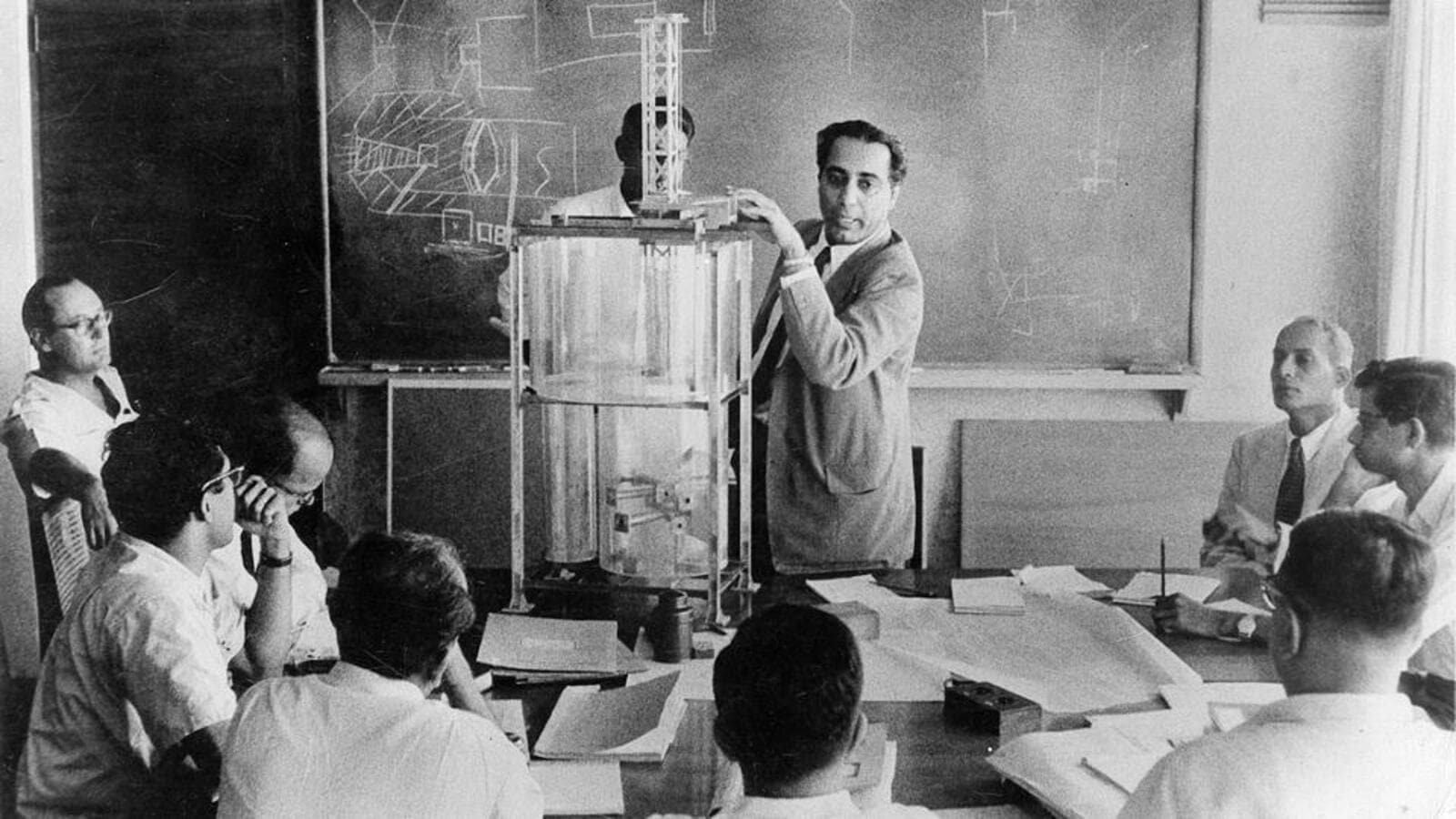
The Three-Stage Nuclear Power Programme (1954)Bhabha’s most visionary contribution was a unique, self-reliant strategy tailored to India’s resource profile: modest uranium reserves but ~25 % of the world’s thorium in coastal monazite sands. Presented in 1954, the plan aimed for energy independence without perpetual imports.
The closed-fuel-cycle design recycles material at each stage, ultimately unlocking thorium for centuries of clean energy.


Broader Impact and LegacyBhabha also:
- Tata Institute of Fundamental Research (TIFR), 1945: Bhabha founded TIFR in Mumbai with support from the Tata Trusts and Jawaharlal Nehru. It became the “cradle of the atomic energy programme,” training scientists and conducting early nuclear research while India still lacked basic infrastructure.
- Atomic Energy Commission (AEC), 1948: Bhabha persuaded Nehru to create the AEC and became its first chairman. This gave India its first formal nuclear policy body.
- Department of Atomic Energy (DAE), 1954: Established under the Prime Minister’s direct oversight, with Bhabha as Secretary.
- Atomic Energy Establishment, Trombay (AEET) / Bhabha Atomic Research Centre (BARC), 1954: Bhabha created this multidisciplinary research campus near Mumbai. It remains India’s premier nuclear research facility and was renamed in his honour after his death.
- Apsara Reactor, 1956: Under Bhabha’s leadership, India built and commissioned Asia’s first nuclear research reactor at Trombay. The 1 MW swimming-pool-type reactor went critical on 4 August 1956 using enriched uranium supplied by the UK. It was used for neutron physics, isotope production, materials testing, and training—laying the practical groundwork for the entire program.
The closed-fuel-cycle design recycles material at each stage, ultimately unlocking thorium for centuries of clean energy.
- Hosted the first UN Conference on the Peaceful Uses of Atomic Energy (Geneva, 1955) as its president.
- Secured early international cooperation (e.g., heavy water and the CIRUS reactor with Canada).
- Built a strong emphasis on self-reliance while keeping both civilian power and strategic options open.
India’s Three-Stage Nuclear Power Programme is a visionary, closed-fuel-cycle strategy devised by Homi Jehangir Bhabha in the 1950s (formally adopted in 1958). It exploits India’s modest uranium reserves (about 2% of global) while leveraging its vast thorium reserves (about 25% of the world’s, mainly in monazite sands along the southern coasts) for long-term energy independence and sustainability.
The programme uses reprocessing (“reprocess to reuse”) so spent fuel from one stage feeds the next, multiplying energy output from limited resources and minimising waste. It aims for a self-sustaining thorium cycle that could power India for centuries. Overview of the Three StagesHow the Fuel Cycle Flows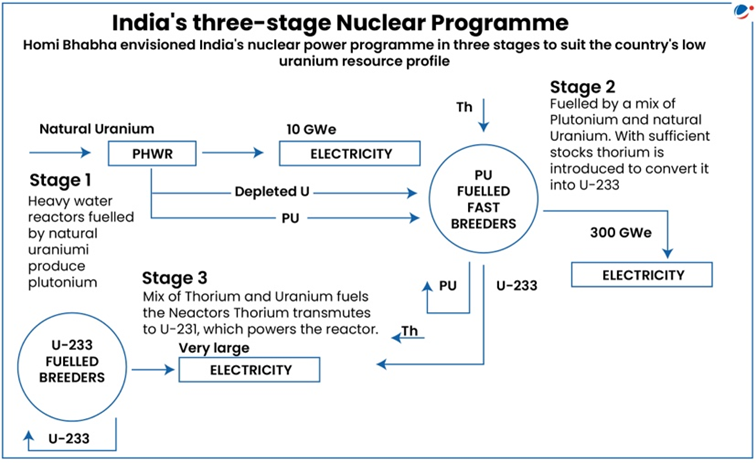
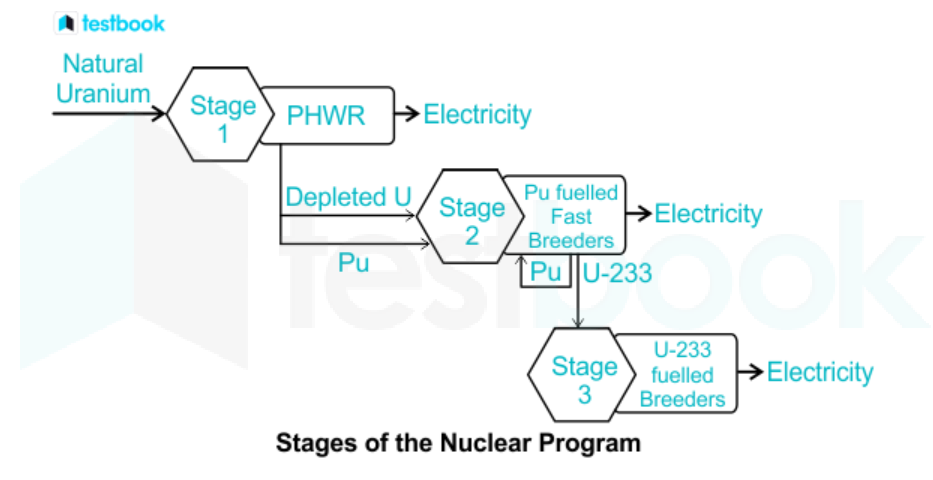
Technical Highlights & Advantages
Challenges & Timeline
The programme uses reprocessing (“reprocess to reuse”) so spent fuel from one stage feeds the next, multiplying energy output from limited resources and minimising waste. It aims for a self-sustaining thorium cycle that could power India for centuries. Overview of the Three StagesHow the Fuel Cycle Flows
- Stage 1 (PHWRs) → Produces electricity + spent fuel containing Pu-239 and depleted uranium.
- Reprocessing → Extracts Pu-239.
- Stage 2 (FBRs) → Uses Pu-239 to fission for power while breeding more Pu-239 (net gain) from U-238 blankets. Once sufficient Pu inventory is built, thorium blankets are introduced to produce U-233.
- Stage 3 → U-233 (fissile) + Th-232 (fertile) in thermal breeder reactors. The cycle becomes largely self-sustaining, with thorium providing the bulk of the fuel.
- Breeding ratio > 1 in FBRs: The reactor produces more fissile material than it consumes — a key “breeder” feature.
- No moderator needed in Stage 2 (fast neutrons enable efficient breeding).
- Thorium focus in Stage 3: India’s thorium can yield enormous energy potential (estimates suggest 200+ years of power at current scales once fully deployed).
- Closed cycle: Dramatically reduces waste volume and long-term radiotoxicity compared to open cycles used elsewhere.
- Self-reliance: Designed around indigenous resources and technology (developed by BARC, IGCAR, NPCIL, and BHAVINI).
- Delays: The PFBR faced significant construction and regulatory hurdles (originally slated for 2010).
- Stage 3: Still in technology demonstration phase. Prototypes like the AHWR are under development; large-scale deployment is expected in the coming decades.
- Scaling: Moving from prototype to commercial fleet of FBRs and then thorium reactors requires massive investment and further R&D.
India’s Three-Stage Nuclear Power Programme stands out globally as one of the most distinctive and ambitious strategies. Designed by Homi Bhabha in the 1950s, it is explicitly tailored to India’s resource profile: modest uranium reserves but ~25% of the world’s thorium. It employs a fully closed fuel cycle with reprocessing and breeding to achieve long-term energy independence, transitioning ultimately to thorium-based power that could sustain India for centuries.
Most other countries follow simpler open (once-through) fuel cycles using enriched uranium in light-water reactors (LWRs), with spent fuel stored or disposed of as waste. A few pursue partial closed cycles (reprocessing plutonium for mixed-oxide/MOX fuel), but none match India’s integrated, multi-decade breeding-to-thorium roadmap. Key Global Comparison (as of April 2026)
Global nuclear fleet context (April 2026): ~376–390 GW total capacity from ~413–437 operable reactors. Five countries (US, France, China, Russia, South Korea) account for ~70%+. Growth is concentrated in Asia; many Western nations focus on life extensions or small modular reactors (SMRs) rather than breeders. Why India’s Approach Is Unique
Most other countries follow simpler open (once-through) fuel cycles using enriched uranium in light-water reactors (LWRs), with spent fuel stored or disposed of as waste. A few pursue partial closed cycles (reprocessing plutonium for mixed-oxide/MOX fuel), but none match India’s integrated, multi-decade breeding-to-thorium roadmap. Key Global Comparison (as of April 2026)
Global nuclear fleet context (April 2026): ~376–390 GW total capacity from ~413–437 operable reactors. Five countries (US, France, China, Russia, South Korea) account for ~70%+. Growth is concentrated in Asia; many Western nations focus on life extensions or small modular reactors (SMRs) rather than breeders. Why India’s Approach Is Unique
- Resource-Driven Innovation: Unlike uranium-rich nations (e.g., US, Australia) that use cheap once-through cycles, India engineered a “multiply-then-switch-to-thorium” pathway. Stage 1 PHWRs produce plutonium; Stage 2 FBRs breed more plutonium and U-233 from thorium blankets; Stage 3 unlocks thorium abundance.
- Breeder Leadership: With PFBR criticality, India joins Russia as one of only two nations operating (or about to operate) commercial-scale fast breeders. Most countries abandoned them decades ago due to technical complexity, high costs, sodium-coolant safety issues, and proliferation concerns (plutonium production).
- Thorium Leadership: India leads in thorium neutron physics and commitment. China’s TMSR-LF1 is a small experimental molten-salt thorium reactor (breeding confirmed 2025), but it remains R&D-scale. No other nation has a national program comparable to India’s Stage 3.
- Closed Cycle Maturity: Full reprocessing + breeding minimizes waste and uranium imports. Most nations (especially the US) treat spent fuel as waste; France recycles plutonium once but does not pursue multi-stage breeding at India’s scale.
- Open-cycle majority → Simpler, cheaper short-term but uranium-intensive and waste-heavy long-term. Global uranium demand is rising; breeders/closed cycles extend resources dramatically.
- Advanced reactor revival → Many countries (US, China, Russia) now pursue Gen IV/SMRs for flexibility, but India’s program is uniquely sequential and thorium-centric.
- Energy security angle → India’s model prioritizes independence; others focus on rapid deployment (China) or decarbonization (France) using proven LWRs.
No, there is no credible evidence that Lal Bahadur Shastri was assassinated or that the CIA (or any foreign power) killed him. His death on January 11, 1966, in Tashkent remains officially attributed to a heart attack, but the absence of a post-mortem, reports of unusual marks on his body, missing medical records, and repeated government refusals to declassify files have kept conspiracy theories alive for six decades.
These theories frequently pair Shastri’s death with Homi J. Bhabha’s plane crash 13 days later, alleging a plot to derail India’s nuclear ambitions. Like the Bhabha claims, they rely on the same highly dubious source and lack any forensic, documentary, or official corroboration.Established Facts of Shastri’s Death
Shastri had been under enormous stress from the war, but he had no publicly known history of serious heart disease.Origin and Problems with the Conspiracy TheoriesTheories exploded almost immediately and include:
Why the theories lack credibility:
These theories frequently pair Shastri’s death with Homi J. Bhabha’s plane crash 13 days later, alleging a plot to derail India’s nuclear ambitions. Like the Bhabha claims, they rely on the same highly dubious source and lack any forensic, documentary, or official corroboration.Established Facts of Shastri’s Death
- Date and context: Early hours of 11 January 1966, in a Soviet government dacha in Tashkent (then USSR). Shastri, aged 61, had just signed the Tashkent Declaration the previous day, a Soviet-brokered peace agreement ending the 1965 Indo-Pak War with Pakistan’s President Ayub Khan.
- Official cause: Myocardial infarction (heart attack), according to the joint medical report by Shastri’s personal physician Dr. R.N. Chugh and Soviet doctors. He reportedly woke up coughing severely after dinner and collapsed before help arrived.
- No post-mortem: None was conducted in Tashkent or upon return to India. The body was embalmed and flown back; a state funeral followed in New Delhi.
- Family observations: Upon receiving the body, wife Lalita Shastri and relatives noted blue patches, cut marks (including on the neck), and blood-soaked bedding. They alleged foul play (poisoning) from the start.
Shastri had been under enormous stress from the war, but he had no publicly known history of serious heart disease.Origin and Problems with the Conspiracy TheoriesTheories exploded almost immediately and include:
- Poisoning (in food, drink, or an overturned thermos in his room).
- Foreign intelligence: CIA (to block India’s nuclear push, as Shastri supported Bhabha); KGB; or even Pakistani agents.
- Internal plot: Rivals within Congress (e.g., Indira Gandhi faction).
Why the theories lack credibility:
- No autopsy or toxicology means no forensic proof of poison (or its absence).
- Soviet and Indian governments jointly investigated and ruled natural causes; no credible declassified records from any side (US, Russia, India) support sabotage.
- A 1977 inquiry (Narain Committee under the Janata Party) found insufficient evidence for foul play.
- RTI requests since 2009 have been denied by the Prime Minister’s Office citing “national security” and “foreign relations.” One classified file exists but remains sealed.
- Timing and geopolitics: Shastri’s death came amid Cold War tensions and India’s post-1962 push toward nuclear self-reliance. The lack of transparency (no autopsy, sealed files) created a vacuum filled by speculation.
- Family persistence: Lalita Shastri, son Sunil Shastri, and grandson Siddharth Nath Singh have repeatedly called for a full probe.
- Cultural echo: Books, the 2019 film The Tashkent Files, documentaries, and social media keep the debate alive. As of 2026, articles and discussions still note the unresolved questions without new evidence.

